Printing the Future: How 3D Construction Could Reshape Bergen County Real Estate
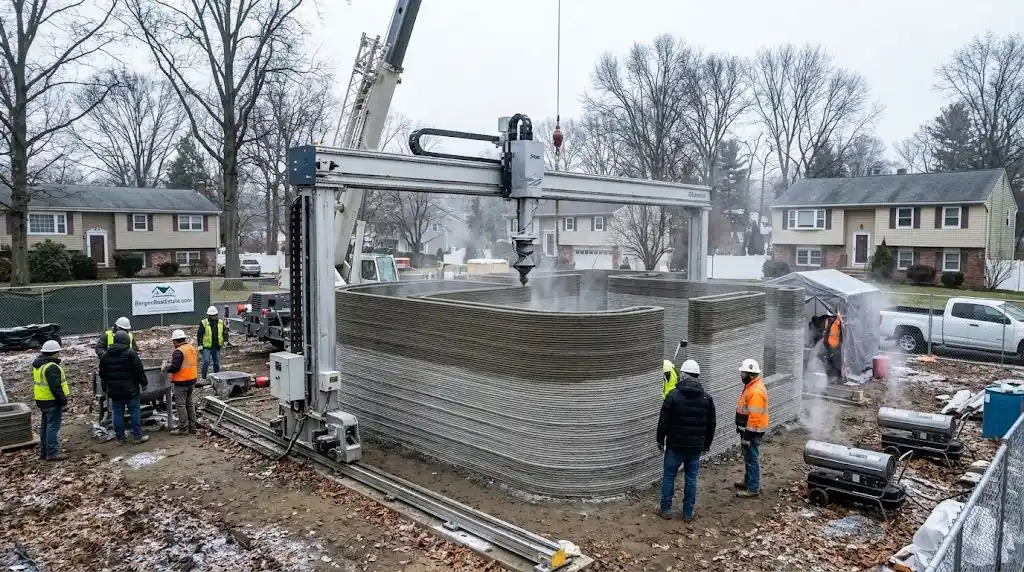
Once viewed as a novelty, 3D concrete printing is rapidly emerging as a transformative force in both residential and commercial real estate development. As local markets face ongoing challenges with housing inventory, rising labor costs, and material waste, robotic 3D construction offers a compelling, high-efficiency alternative for builders and developers across Northern New Jersey.
The Economic Edge: Drastically Reduced Costs and Timelines
The most immediate impact of 3D printed housing is its profound cost-effectiveness. By eliminating the need for many traditional, expensive materials and reducing the heavy reliance on skilled labor, 3D-printed houses can cut the cost of traditional homebuilding by up to 45 percent. The automation involved mitigates the impact of labor shortages while decreasing human error, ensuring consistent construction quality. Furthermore, construction timelines are drastically compressed. A standard 1,200-square-foot home can have its primary structure printed in roughly 20 hours, with the entire completion process taking approximately 10 days.
Sustainability, Durability, and Design Innovation
Beyond the balance sheet, 3D printing represents a major advancement in sustainable construction. By precisely depositing materials only where they are needed, the technology reduces concrete waste by up to 95 percent and cuts energy consumption by 50 percent compared to conventional building processes. The continuous layering technique also results in incredibly robust structures. These homes feature enhanced structural integrity, making them highly resilient to environmental stresses and extreme weather. Additionally, architects benefit from unprecedented design flexibility, allowing for complex curved walls and customized textures without incurring exorbitant additional costs.
Local Viability and Commercial Expansion in New Jersey
While 3D printed homes are a newer phenomenon, New Jersey already possesses regulatory frameworks for alternative housing, such as modular builds, which must comply with the state’s Uniform Construction Code. In Bergen County municipalities like Paramus, non-traditional code-compliant homes are permitted provided they adhere to local zoning rules, including strict caps like 35 percent building coverage and 40 percent overall lot coverage.
The application of this technology is also expanding rapidly into the commercial sector. Local industry pioneers, such as Union City based New Era 3D, are currently utilizing robotic 3D concrete printing for multi-unit housing developments as well as commercial government and institutional programs. Their capabilities extend to printing specific architectural features, including large-scale printed walls and columns, proving that the technology can be scaled for complex commercial spaces.
Defying the Elements: How 3D Concrete Printing Navigates Bergen County’s Cold Winters
Bergen County’s real estate market operates in a climate defined by distinct seasons, including harsh, freezing winters that traditionally stall residential and commercial construction. As 3D concrete printing emerges as a transformative building method in the New York metropolitan area, the technology’s ability to withstand freezing temperatures is a critical factor for local developers. The intersection of advanced material science and automated construction is proving that 3D printing can not only survive Northeast winters but potentially outperform traditional masonry.
The Cold Weather Curing Challenge
At its core, 3D concrete printing relies on highly calibrated chemical reactions. Concrete requires specific environmental conditions to cure properly, with optimal mechanical strength generally achieved at ambient temperatures of around 20°C (68°F) and high relative humidity. When winter temperatures plummet in New Jersey, the cold impacts the human operators, the printing equipment, and the ambient air where each layer of material is deposited. If conditions fall below the threshold required for proper cement hydration, the material cannot cure correctly, necessitating specialized environmental controls.
Winter Resilience and Construction Solutions
To overcome these seasonal limitations without relying entirely on expensive, site-wide heated tents, the industry is deploying highly targeted technological solutions. Innovative construction teams are utilizing specialized radiant heating platforms that apply energy directly to the concrete work rather than attempting to heat the surrounding winter air. This allows for a precisely engineered curing environment even in freezing conditions. Additionally, developers are formulating custom concrete mixes optimized for structural stability across diverse climates. This enhanced resilience allows automated 3D printing to continue functioning through rain and snow weather events that typically force traditional masonry crews to halt work entirely.
Long-Term Thermal Benefits for Homeowners
The impact of winter weather on 3D printing extends beyond the construction phase, offering significant long-term advantages for the end consumer. For future homeowners in the NY metropolitan area, 3D printed structures promise exceptional energy efficiency during the coldest months. Ongoing engineering initiatives are actively developing 3D printed concrete walls that aim to deliver a 50% improvement in thermal resistance compared to traditional builds. By inherently providing better thermal insulation, these homes are distinctly advantageous for cold and mixed-humid environments, ensuring that structures built with additive manufacturing will keep Bergen County residents warmer while lowering their seasonal energy costs.