Navigating the 21st Century ROAD to Housing Act: What It Means for Bergen County Real Estate
The housing landscape across the nation, and particularly in high demand markets like New Jersey, is on the precipice of a significant transformation. On July 11, 2026, the 21st Century ROAD to Housing Act officially became law. Representing the most comprehensive federal housing legislation in a generation, the bipartisan package aims to stimulate housing supply, modernize federal programs, and redefine who can participate in the single family housing market. For real estate professionals navigating the nuances of Bergen County’s residential and commercial sectors, understanding the granular details of this legislation is paramount.
Here are the top three provisions within the bill that will profoundly impact the New Jersey and Bergen County real estate landscape over the next decade.
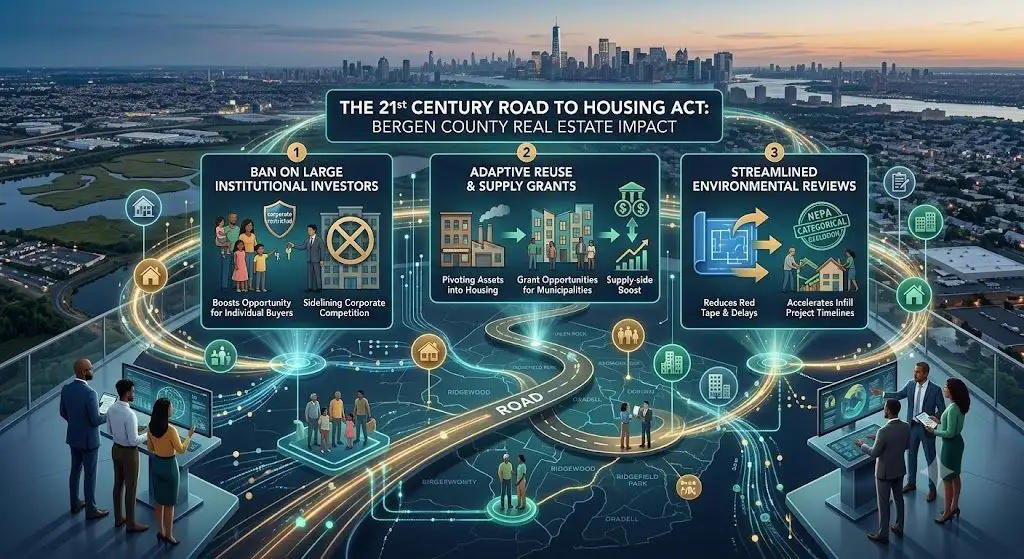
The Ban on Large Institutional Investors
Perhaps the most disruptive component of the legislation is the strict prohibition on large institutional investors acquiring single family homes. Under Section 901 of the Act, entities that have direct or indirect investment control over 350 or more single family homes are now barred from purchasing additional single family properties. This restriction applies to structures containing two or fewer dwelling units. For Bergen County, a market historically plagued by constrained inventory and high barriers to entry, this provision will likely level the playing field for individual homebuyers. By sidelining massive corporate buyers, local families and first-time buyers may face less competition for the limited supply of starter homes and mid-tier properties across the region.
Capitalizing on Adaptive Reuse and Supply-Side Grants
The legislation aggressively targets the ongoing housing shortage by offering substantial financial incentives for local municipalities that modernize their development processes. The bill establishes a $200 million annual competitive grant program for local governments that can demonstrate measurable increases in housing supply through reforms such as streamlined permitting, density bonuses, and zoning changes. Furthermore, it authorizes pilot grants ranging from $1 million to $10 million to help local governments convert vacant commercial or industrial buildings into affordable housing. For commercial real estate professionals in Bergen County, this presents a lucrative opportunity to pivot underperforming assets, such as aging office parks or retail centers, into highly sought after residential developments.
Streamlining Environmental Reviews for Infill Development
Developing property in New Jersey frequently involves navigating a labyrinth of environmental regulations. The 21st Century ROAD to Housing Act seeks to alleviate some of this friction by reforming the National Environmental Policy Act (NEPA) review process. The bill streamlines federal requirements by classifying certain housing-related activities, including the rehabilitation and new construction of residential buildings, as categorical exclusions, provided they do not materially alter environmental conditions. It specifically exempts small scale projects from stringent environmental mandates that often delay modest infill construction and rehabilitation efforts. In a densely populated region like Bergen County, where infill development is often the only viable path for new residential construction, cutting through this bureaucratic red tape will accelerate project timelines and reduce overhead costs for local developers.
Crucial Caveats for Real Estate Professionals
Beyond the primary headlines, there are several nuanced caveats embedded within the legislation that Bergen County real estate professionals must monitor.
- The Build-to-Rent Exception and Seven Year Rule: While large institutional investors are banned from purchasing existing single family homes, the bill preserves a carve out for the build-to-rent and renovate-to-rent sectors. However, this comes with a significant catch. Investors utilizing these exceptions must sell the home to an individual homebuyer after a period of seven years. This mandate is encumbered by a right of first refusal, which introduces a new layer of complexity for long-term portfolio management and commercial financing.
- Appraisal Workforce Expansion: To address bottlenecks in the transaction process, the act bolsters appraiser workforce capacity. The legislation now allows both licensed and credentialed appraisers, including trainee appraisers, to conduct appraisals for FHA insured mortgage lending transactions, which should expedite closings across the state.
- Manufactured Housing Reforms: The bill modernizes the definition of a manufactured home, allowing structures built without a permanent chassis to be treated on par with traditional HUD code homes for financing, sale, installation, and title purposes. While manufactured housing is less common in the immediate New York City suburbs, this could influence development strategies in the more rural borders of Northern New Jersey.
- Implementation Timeline and Penalties: The Act officially takes effect on January 7, 2027. Institutional investors found to be out of compliance with the new purchasing restrictions will face civil penalties of up to $1 million per violation, or three times the purchase price of the property, whichever is greater.
The 21st Century ROAD to Housing Act is not merely a funding bill, but rather a comprehensive policy overhaul designed to reshape the American housing market. As these new regulations are implemented, local expertise and proactive strategic planning will be essential for real estate professionals looking to capitalize on the shifting landscape of Bergen County.
Contact us today for assistance in navigating The 21st Century ROAD to Housing Act.