Commercial Real Estate in Bergen County: A Step-by-Step Guide for Business Owners
Expanding your footprint or launching a new business venture in Bergen County, NJ, is an exciting milestone. Positioned as a premier economic engine just across the Hudson from New York City, our county offers unparalleled access to affluent consumers, major transit corridors, and a thriving business ecosystem.
However, entering the Commercial Real Estate (CRE) market is vastly different from buying a residential home. From unique municipal zoning laws to complex financial structures, the learning curve can be steep.
To help you make an informed, confident decision, here is a straightforward, step-by-step guide to purchasing or leasing commercial property in Bergen County.
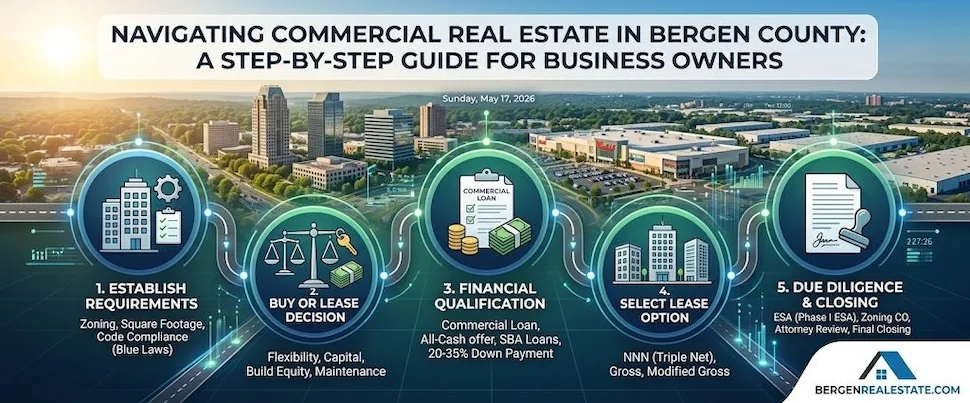
Step 1: Establish Your Business Requirements & Budget
Before looking at properties in Paramus, Hackensack, or Mahwah, you need to precisely define what your business requires to operate legally and efficiently.
- Zoning and Code Compliance: Bergen County is famous for its strict, highly localized zoning laws. A space that looks perfect for a medical clinic might only be zoned for general office use. Furthermore, remember Bergen County’s famous Blue Laws, if you are in retail, your operations in many municipalities will be restricted on Sundays.
- Infrastructure Needs: Calculate your required square footage, ceiling heights, loading dock access, and electrical power capacity (especially critical for tech, manufacturing, or commercial kitchens).
Step 2: The Big Decision: Should You Buy or Lease?
This is the primary crossroads for every business owner. Your choice depends heavily on your current cash flow, long-term growth projections, and tax strategy.
| Feature | Leasing Commercial Space | Purchasing Commercial Property |
| Upfront Capital | Lower (typically 1 to 3 months rent as a security deposit). | High (20% to 35% down payment required). |
| Flexibility | High. Easy to relocate or scale up when the lease expires. | Low. Tied to the physical asset until you sell or lease it out. |
| Asset Growth | None. You are building equity for the landlord. | High. Property appreciation and potential passive rental income. |
| Maintenance | Varied, but often handled or coordinated by the landlord. | You are fully responsible for the building’s structural integrity and upkeep. |
Step 3: Financial Qualification: All-Cash vs. Commercial Loans
Commercial underwriters look at real estate entirely differently than residential lenders. They focus heavily on the property’s income producing potential and your business’s financial health.
If You Are Purchasing:
- The All-Cash Route: If your business has liquid capital, an all-cash purchase makes your offer incredibly competitive in hot Bergen County markets. It eliminates financing contingencies, speeds up the closing process, and saves money on loan origination fees and interest.
- The Commercial Loan Route: Most buyers utilize financing. Expect to put down 20% to 35% of the purchase price as a down payment. Lenders will evaluate your Debt Service Coverage Ratio (DSCR), ensuring the property’s net operating income can comfortably cover the loan payments.
- SBA Loans: Look into government-backed SBA 7(a) or SBA 504 loans. These programs often allow lower down payments (as low as 10%) and fixed, long-term interest rates for owner-occupied business properties.
If You Are Leasing:
- Landlords will require substantial financial disclosure. Be prepared to show 2–3 years of corporate tax returns, a detailed business plan, credit checks, and potentially a Personal Guarantee, meaning you are personally liable for the lease payments if the business fails.
Step 4: Understand Your Commercial Lease Options
If you decide to lease, you aren’t just signing up for a monthly rent check. You must understand how building operating expenses are allocated. Commercial leases generally fall into three categories:
- Triple Net Lease (NNN): You pay a lower base rent, but you are directly responsible for your proportional share of the building’s operating expenses: property taxes, building insurance, and common area maintenance (CAM). NNN leases are highly common in Bergen County retail and industrial spaces.
- Gross Lease / Full Service: You pay one flat monthly fee. The landlord handles all taxes, insurance, utilities, and maintenance. This is common in multi-tenant office buildings and offers the most predictable budgeting.
- Modified Gross Lease: A middle ground. You pay base rent plus a pre-negotiated portion of the operating expenses (e.g., you pay your own utilities and interior maintenance, while the landlord covers taxes and insurance).
Step 5: Assemble Your Local Deal Team
Do not try to navigate a commercial transaction alone. You need localized expertise to protect your interests:
- Commercial Real Estate Tenant/Buyer Broker: A specialized CRE broker costs you nothing as a buyer or tenant (the seller/landlord pays the commission), but they give you access to off-market inventory and critical data on recent local comps.
- NJ-Licensed Commercial Real Estate Attorney: Commercial contracts do not have a standard “attorney review” cushion like residential contracts. An attorney is vital for negotiating lease escalations, environmental liabilities, and structural responsibilities.
- Architect/Contractor: Before signing anything, bring an expert to evaluate the cost of the Tenant Improvements (TI) or fit-out needed to customize the space for your operations.
Step 6: Due Diligence, Environmental Checks, and Closing
Once your offer is accepted or your letters of intent (LOI) are signed, the due diligence phase begins. In New Jersey, this step requires careful attention:
- Phase I Environmental Site Assessment (ESA): Because of Bergen County’s rich industrial history, lenders will almost always require a Phase I ESA to ensure there is no soil or groundwater contamination from prior uses. Under NJ’s strict environmental laws, acquiring contaminated property can make you liable for cleanup costs, even if you didn’t cause them.
- Certificate of Occupancy (CO): You must apply to the local municipality for a new CO or a change-of-use permit. Do not finalize your lease or purchase without a contingency clause stating the deal is nullified if the town denies your business operations permit.
Partner With Bergen County’s Commercial Experts
Whether you are looking for a retail storefront in Ridgewood, a flex warehouse in Ridgefield Park, or professional medical office space in Englewood, timing and local intelligence mean everything in 2026.
Ready to explore the commercial landscape? Contact the team at BergenRealEstate.com today. We will help you analyze the numbers, handle the local zoning nuances, and secure a space that positions your business for long-term profitability.